Set 14
Grade 12 FM: 75
Compulsory English Time: 3 hrs.
1. Read the given text and complete the activities 15
Have you ever wondered how language works? How we are able to communicate with each other using words and sentences? Or how we are able to understand what others are saying to us? Language is a complex system that involves many different components, including sounds, grammar, and meaning. In this passage, we will explore some of the key aspects of language and how they work together to enable communication.
One of the most basic components of language is phonology, or the study of sounds. Every language has its own set of sounds that are used to create words and sentences. These sounds are organized into a system of phonemes, which are the smallest units of sound that can distinguish meaning in a language. For example, in English, the sounds /p/ and /b/ are phonemes because they can change the meaning of words. Think about the words “pat” and “bat” – changing the /p/ sound to a /b/ sound changes the meaning of the word entirely.
Another important aspect of language is syntax, or the way that words are put together to form sentences. Every language has its own rules for syntax, which determine the order in which words can be used to convey meaning. For example, in English, the basic word order for a sentence is subject-verb-object. So, “The cat chased the mouse” is a grammatically correct sentence, while “Mouse chased cat the” is not.
But language is not just about sounds and sentence structure – it is also about meaning. Semantics is the study of meaning in language, including how words relate to each other and how context affects interpretation. For example, the word “bank” can refer to a financial institution, a river bank, or even a verb meaning to tilt or incline. The meaning of the word depends on the context in which it is used.
A. Answer the given questions 5
a. What is phonology?
b. Can you give an example of a phoneme in English?
c. What is syntax?
d. How does context affect the meaning of words in language?
e. Give a suitable title for the text.
B. Choose the best answer 5
a. Which of the following is NOT a component of language?
a) Phonology b) Syntax c) Semantics d) Psychology
b. What is a phoneme?
a) The smallest unit of meaning in a language
b) The basic unit of sound in a language
c) The way that words are put together to form sentences
c. What is syntax?
a) The study of sounds in language
b) The study of meaning in language
c) The way that words are put together to form sentences
d. Which of the following is an example of how context affects meaning in language?
a) The word “book” can refer to a physical object or an action
b) The sounds /p/ and /b/ can change the meaning of a word
c) The basic word order for a sentence in English is subject-verb-object
e. What is semantics?
a) The study of sounds in language
b) The study of meaning in language, including how words relate to each other and how context affects interpretation
c) The way that words are put together to form sentences.
2. Write ‘True’ for true statements and ‘False’ for false statements:5
a. Language involves many different components, including sounds, grammar, and meaning.
b. Phonemes are the smallest units of meaning in a language.
c. Every language has its own rules for syntax, which determine the order in which words can be used to convey meaning.
d. The meaning of a word in language is always the same, regardless of the context in which it is used.
e. Semantics is the study of meaning in language, including how words relate to each other and how context affects interpretation.
2. Write long answers to the following questions in about 150 words each. 2×5=10
a. The author talks about the eyes in many places; the eyes of the shaven monks and nuns, eyes in the window and door panels, the eyes of the Himalayas, the eyes of the paralyzed boy, the eyes of the welcoming villagers and above all the half – closed eyes of the Buddha. Explain how all the instances of eyes contribute to the overall unity of the story. [The Half – closed eyes of the Buddha and the Slowly Sinking Sun]
b. Discuss the late eighteenth – century Nepali society as portrayed in terms of the relation between the king and his subjects as portrayed in the play. [The Bull]
3. Write short answers to the following questions in about 75 words each. 5×2=10
a. What does the map look like and how do Evan and Hooker interpret it? [Treasure in the forest]
b. Why do the inhabitants of Milk Wood bow to the setting sun ‘but just for now’? [Every morning I Wake]
c. Why does the poet appeal for solidarity among the people? [The Awakening Age]
d. Why did he dislike school? [On Libraries]
OR,
Why does marriage matter to men? [Marriage as a Social Institution]
e. Discuss magical realism in the story ‘A Very Old Man with Enormous Wings’
4. Explain the given diagram that presents the purpose of internet use among the 200 students of a university.
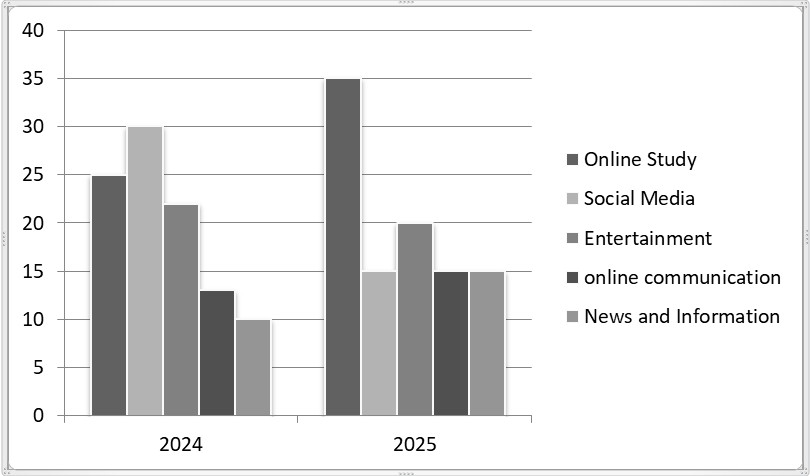
#Note: these data are given in percentage
5. Write a diary entry of the day, either interesting or miserable; you have been greatly influenced by. Write what thoughts you were having that day. 8
6. When any sport team players play in a home ground, it gets a huge support from the audience in the stadium. Does this support them to win the match or the players may feel pressure to win and thus lose? What do you think? Write in about 300 words. 10
7. Do as instructed: 10
a. This examination is _________ than the previous one. (supply correct form of adjective or adverb)
b. If you had left earlier, you _______ have caught the bus. (supply correct form of modal verb)
c. He made _________ mistakes in his writing, which cost him marks. (much/many/few/little)
d. He said, ‘Wow! You are wearing a nice watch’. (report the sentence)
e. I love people taking me to expensive restaurants. (change into passive voice)
f. I was accompanied to the hospital _______ my friend. (supply correct preposition)
g. Mathematics ______ his favorite subject when he was in school. (is/are/was/were)
h. They gave him award this year. He has helped the poor of his society from fifteen years. (join using – therefore)
i. This is the man. I gave some money to him this morning. (join using appropriate relative clause)
j. He tried _______ the heavy box but he couldn’t lift it. (move/ to move/ moving)
8. Choose the correct answers: 5
a. Identify the part of speech of the underlined word:- ‘She quickly ran to the store.’
i. noun ii. verb
iii. adverb iv. adjective
b. Which phrasal verb means ‘to solve or understand something complex after careful consideration’?
i. iron out ii. fathom out
iii. brush up on iv. talk over
c. When the company launched its new product, it really hit the ground running, gaining thousands of customers in the first week. Choose the option that best explains the meaning of the highlighted phrase:
i. made a slow start
ii. avoided responsibility
iii. made a slow start
iv. started something energetically and successfully
d. As a student your handwriting should be _______
i. Nasty ii. Illegible
iii. Incomprehensible iv. Legible
e. The synonym of the word ‘Crafty’ is __________.
i. Lousy ii.Dull
iii.Artful iv.Novice
All the Best

Post Comment